Showing posts with label anti-inflammatory diet. Show all posts

Saturday, January 28, 2012

Healing Your Skin with Food!! Part 2 on "The Clear Skin Diet"

Yay!  Spots Gone!:-)
Today I want to follow up on my previous post "Ok Lets Talk Skin!  New Book to Recommend:  The Clear Skin Diet!"  Since that post two weeks ago I have continued to follow Drs Logan and Treloar's nutritional program to feed my skin the right nutrients it needs to heal!!  I'm delighted to report that after applying my dermatologist recommended products, completely eliminating soy from my diet since mid-December and strictly adhering to my omega-3 fatty acid supplement regimen, the "spots" are gone!! I actually was complimented twice this week on my skin sans makeup!  Whoohooo!  

For my omega-3's, I'm taking a multi-pronged approach.  It turns out that there is soy in a lot of those algae-based vegan omega-3 supplements!  So they were out for me.  I started doing more research and now I'm targeting components of omega-3's:  both DHA and EPA.   After reading several studies on brain function associated with DHA and the difficulty vegans sometimes have in converting EPA into DHA, I decided to splurge and get Dr. Fuhrman's liquid pure DHA.  Its expensive!  I put a few drops into my food or drink each day and consume that.  I also have been eating a lot of chia seed (which, like flax I think I'm now having a reaction too--argh!) so I'm heading back to my good old fish oil supplements for necessary EPA.  If what I just wrote sounds like a foreign language (and it would have been to me a few weeks ago!) then check out the following:


2) a fantastic series on fats by the Vegan Epicurean:

The additional omega-3's have been amazing for all of my skin in general--the winter dryness has decreased significantly.  Of course I'm still using my dermatologists regimen of various cleaners and lotions (I think this regimen is brilliant so check out the comments on the previous skin post for details on that regimen).  One caveat, I have noticed though that my skin is very very sensitive to what I put in my body.  A little grease--boom, new spots.  Too much of one thing (excessive chia seed--and yes, I know this is an EFA and it doesn't make sense but its the truth!)--boom, new spots.  And so I've continued to read The Clear Skin Diet by Dr. Alan Logan (ND) and Dr. Valori Treloar (MD) closely and have learned SO much about nutrition in general and what is best nutrient-wise for skin care!  

Last post I shared Drs Logan and Treloar's assessment of what the native Japanese & other ethnic groups with gorgeous clear skin eat (and we should too!).  

From p.163 of The Clear Skin Diet by Dr. Alan Logan (ND) and Dr. Valori Treloar (MD), ethnic groups with beautiful skin eat:

1. Less processed foods (my side note: this can be a vegan problem too--a lot of the "fake meats" are very processed)
2.  More colorful antioxidants
3.  Greater intake of omega-3 fatty acids
4. Fewer foods capable of spiking blood sugar
5. More fiber 

I am now hitting all five of the recs instead of just four and wanted to also share with you Drs Logan and Treloar's list of the highest antioxidant-rich foods that feed your skin and the doctors' advice on the specific types of food to embrace to have clear, healthy skin!   

Now, as you long-term readers know, I've posted on anti-inflammatory and antioxidant-rich foods in the past regarding my approach to pain management, but I wanted to share Drs Logan and Treloar's list in particular as it does a nice job of detailing out in a more extensive list all the specific fruits and vegetables that are the most antioxidant-rice foods!!  


Acai
Alfalfa
Apple sauce
Apple vinegar
Artichoke
Asparagus
Avocado
Basil
Beans (red, pinto, black & navy)
Beets
Bell peppers
Black-eyed peas
Black pepper
Blackberry
Blueberry
Broccoli
Brussels sprouts
Cherries
Chili powder
Cilantro
Cinnamon
Cloves
Cocoa
Cranberry
Dates
Eggplant
Elderberry
Figs
Fuji apples
Ginger
Green tea
High-quality olive oil ***
Kale
Nuts (walnuts in particular)
Oatmeal and whole grain breakfast cereals
oranges
Oregano
Parsley
Peaches
Pears
Plums
Pomegranate
Prunes
Purple califlower
Purple sweet potato
Raspberry
Red cabbage
Red grapes
Red leaf lettuce
Red potatoes
Spinach
Strawberry
Tangerines
Tumeric

***(NOTE:  Dr. Esselstyn FIRMLY recommends against olive oil & oils of all kinds)


Next time I'll finish up this series by sharing what Drs Logan and Treloar which of these foods will get you the most "bang for your buck" so to speak for your skin!! 

Finally, if you want some extra data on how to get the most antioxidants out of our foods, check out The Healthy Librarian's post on the subject:  http://www.happyhealthylonglife.com/happy_healthy_long_life/2010/03/antioxidants.html

The medical information on this site is provided as an information resource only, and is not to be used or relied on for any diagnostic or treatment purposes. This information is not intended to be patient education, does not create any patient-physician relationship, and should not be used as a substitute for professional diagnosis and treatment.  Please consult your health care provider before making any healthcare decisions or for guidance about a specific medical condition. The Happy Rehab Doc expressly disclaims responsibility, and shall have no liability, for any damages, loss, injury, or liability whatsoever suffered as a result of your reliance on the information contained in this site.  By visiting this site you agree to the foregoing terms and conditions.

Wednesday, January 11, 2012

Ok Lets Talk Skin! New Book to Recommend: The Clear Skin Diet!

Before

Ok so I've been having some issues with my skin that began a few months into my change to going strictly vegan! This perplexed me because I heard from so many others that the vegan thing has been wonderful for skin!  But since early November, my previously pretty perfect skin (and yes, this is my one vanity--first of all its genetic so I didn't do anything special and second of all it was the only thing I could really feel pretty about when I was obese so indulge me!!) broke out into spots that my new dermatologist calls "folliculitis" or irritation of the hair follicles.  It looks like teenage acne but it isn't.  


After (this past month)!
Of course it has caused me significant distress to look in the mirror every day (I think I was driving my husband crazy as I pointed out every new spot that cropped up!  His favorite phrase was: "welcome to my teenage years honey.")


Anyways, so when this all happened I started trying to figure out where I went wrong.  Nothing major in my life had changed--I had the usual stressors with work and family members being ill but this was normal for me.  So I started looking at what I ate.  The only new food that I can ascertain that I added in a major way in early November was that we went from eating soy maybe once every few months to soy everyday.  And before you point out the obvious--yes I know that I also eliminated animal products, but dairy and other meats are known to be a huge pro-inflammatory agent that cause skin issues so I really don't think the animal-free diet was the cause.  With this in mind, as a first step I eliminated soy. 


I have to be honest and share that this soy elimination has really, really upset me.  My dietary program is already quite restrictive in many ways--no sugar, no gluten, vegan....so to add soy to it too!  Argh!!  But I'm attempting to embrace a new cooking opportunity (trying to stay positive here!), so I'm searching out non-soy recipes.  So let me know if you all have any low-fat/no-fat non-soy, gluten-free, sugar-free recipes please?  Much appreciated :-)


Anyways, back to the skin problem.  With the elimination of soy I did notice that my skin started to improve.  But it was still not back to normal. So I bit the bullet and went to my first dermatology appointment.  And there, I really hit the jackpot.  I expected a very traditional doc as I knew he had a military background and was well over the age of 70 but much to my surprise, within the first two minutes of the visit he started talking nutrition!!  And then he actually complimented me on my dietary choices.  Whaaaat?  I know, you are all shocked here but he actually liked the vegan thing and the gluten-free thing and the sugar-free thing.  


Full disclosure, he wasn't 100% on board with my soy theory--mostly he thought it was likely not a true allergen but more like a "trigger" for beginning eczema (which is what he described my spots as!). And of course now my skin bumps were infected (helllo work in health care, land of disease!) and so I needed oral antibiotics on top of everything else!  He also gave me an excellent skin product regimen which I'm happy to share with all of you if you would like.  I say excellent because its been less than a week since the appointment and my skin is nearly completely clear (of course I also haven't had any soy for 2 1/2 weeks so I can't give the products all the credit but my skin certainly feels really nice!):-) 
Today
Soy Free, Omega-3 rich,
Dermatology Products & Antibiotics


Back to what he said about nutrition.  You all know I'm a fan of food-based treatment so isolating a soy allergy or "trigger" was not enough in my book.  I started wondering why I, with my anti-inflammatory diet, had developed a completely inflammatory disease (eczema)!  I have a strong family history of eczema so this diagnosis actually wasn't all this surprising but hearing that it was a potential diagnosis brought me back to reflect on whether I had made the right anti-inflammatory food choices.  Remember my list in my post  HERE? 


I found the answer in a book my dermatologist recommended:  The Clear Skin Diet by Dr. Alan Logan (ND) and Dr. Valori Treloar (MD).  I'm not finished reading it yet but I can tell you that from what I've read so far it is AMAZING!!!  It definitively demonstrates that diet DOES have a major impact on skin AND also reinforces my assertion that the reason most physicians don't prescribe nutritional treatments is that we are generally not educated in nutrition at all & therefore are very skeptical of data supportive of nutritive cures!  Don't get me started on the need to change medical education or else this post will be ridiculously long!  Suffice to say (and I'll write more about this in a second post because this one is getting too long), Drs Logan and Treloar give some fantastic advice.  


From what I can tell so far, my main issue appears to be a omega-3 deficiency.  This makes sense to me because the only other major change in my diet except for the soy was dropping my fish oil daily in favor of flaxseed meal!  Despite my own advice, I obviously wasn't loving the flaxseed meal (I ate it VERY inconsistently) so I have started to search out other plant-based omega-3 sources (in the meantime I'm back to fish oil daily).  


I do still strongly believe soy is at the root of this as well because it IS considered an inflammatory food for some, so I'm going to continue to eliminate it for another month & then start a few gentle food challenges to see if it really does have an impact. But for the omega-3 issue I'm going to start taking The Healthy Librarian's advice and try a seaweed-based omega-3 supplement with DHA (good for the brain).  In the meantime, I'm going to keep reading this book!  


I'll end with Drs Logan and Treloar's assessment of what the native Japanese & other ethnic groups with gorgeous clear skin eat (and we should too!).  From p.163 of , ethinic groups with beautiful skin eat:
1. Less processed foods (my side note: this can be a vegan problem too--a lot of the "fake meats" are very processed)
2.  More colorful antioxidants
3.  Greater intake of omega-3 fatty acids
4. Fewer foods capable of spiking blood sugar
5. More fiber 


Sounds pretty darn good to me!  Tune in to my next post on skin to get Drs Logan and Treloar's list of the highest antioxidant-rich foods that feed your skin and the doctors' advice on the specific types of food to embrace to have clear, healthy skin!   


Coming Up:
  • Treating Pain with Food--more thoughts
  • Foods That Make You Feel Good (A New Series Featuring Individual Foods & Their Nutrient Power)
Coming Up on Medical System Tuesdays:
  • A Toolbox for Health:  Communicating with Your Doctor (Part 2)!
    The medical information on this site is provided as an information resource only, and is not to be used or relied on for any diagnostic or treatment purposes. This information is not intended to be patient education, does not create any patient-physician relationship, and should not be used as a substitute for professional diagnosis and treatment.  Please consult your health care provider before making any healthcare decisions or for guidance about a specific medical condition. The Happy Rehab Doc expressly disclaims responsibility, and shall have no liability, for any damages, loss, injury, or liability whatsoever suffered as a result of your reliance on the information contained in this site.  By visiting this site you agree to the foregoing terms and conditions.

Thursday, January 5, 2012

Favorite Plant-Strong COOKBOOKS!! :-)

Ok! Since becoming a vegan I have relied on outstanding plant-strong bloggers heavily for their excellent recipes but I also have continued to use cookbooks as well.  Next time I'll discuss my go-to recipe blogs & who my favorite bloggers are and why (for a sample you can check the left sidebar of the blog for links!), but for today, lets talk cookbooks!


When planning our weekly food plan I tend to pick one cookbook to focus primarily on & then add in recipes from blogs as well.  Getting used to cooking so frequently was definitely an adjustment but since we really can't find anything to eat at work, I really rely on my homemade food to get through the day!  The thing I have discovered is that in the 20 mins it takes to get take-out and get back home you can have dinner practically ready to eat in that same timeframe AND know what is in the food you are eating!  (even less if all you are doing is heating up food from a weekend bulk cook).  


Oh and in case you missed my earlier post on my top 3 kitchen appliances, you can access it here.


For now, I definitely have a set of favorite vegan cookbooks and I'll share them with you in this post.  Do you have a favorite that isn't on my list??  Would LOVE to hear of ideas for new awesome ones!


Favorite Cookbooks:

1) The Happy Herbivore Cookbook by Lindsay Nixon.  If there was one cookbook I could recommend as a starter for plant-based eating, this would be it. 
2) Vegan on the Cheap by Robin Robertson:  My second favorite is a highly awesome book for those (like us) on a tight budget! 
  • every recipe is <$2.50 a serving with a lot around the $0.50/serving range.  
  • she helps you figure out how to replicate the more expensive vegan items with homemade versions--seitan, vegetable stock, mayo, "big stick pepperoni."  AND how to organize your kitchen.
  • if you are going oil-free per Dr. Esselstyn's program (like me) you do need to substitute for oil 
  • Sweet-Potato, Roasted Tomato,
    Spinach & Peanut Soup!

  • the food is fantastic--Robin Robertson is an amazing chef--The Healthy Librarian's version of her Sweet Potato, Spinach, Fire-Roasted Tomatoes, and a Bit of Peanut Butter Soup is one of our favorites (that recipe is from a different one of her cookbooks but all of her recipes are of this quality)
  • Brilliant new cookbook added to my collection this week
  • First recipe, the potato soup, was very good
  • Fascinating to discover that you can cook things like squash and poached pears in the slow cooker!
  • LOVE our 3-in-1 slow cooker so I'm going to be all about this book!
  • Its organized really well--love that it clearly identifies the recipes as soy and gluten-free, etc 
  • I like its "The night before" and "In the morning" sections to each recipe so you can prep it the night before and then toss it in the slow cooker in the morning to cook all day!  

  • The cookbook from the Forks Over Knives film
  • Really excellent variety of plant-based options to choose from, 125 recipes from 25 vegan chefs including Mrs. McDougall, Mrs. Esselstyn, Mrs. Campbell, Chef AJ, Rip Esselstyn and many more.  
  • Great for new fresh ideas when you are getting in a rut!
  • Need to substitute for oil in some recipes but a lot of recipes without oil as well.
  • Favorite:  Polenta Pizza with Herbed Cashew Creme! (made that for Christmas for my family & they loved it!) YUM!

  • New favorite--got it this week and have made 2 recipes so far.  Both have been OUTSTANDING!
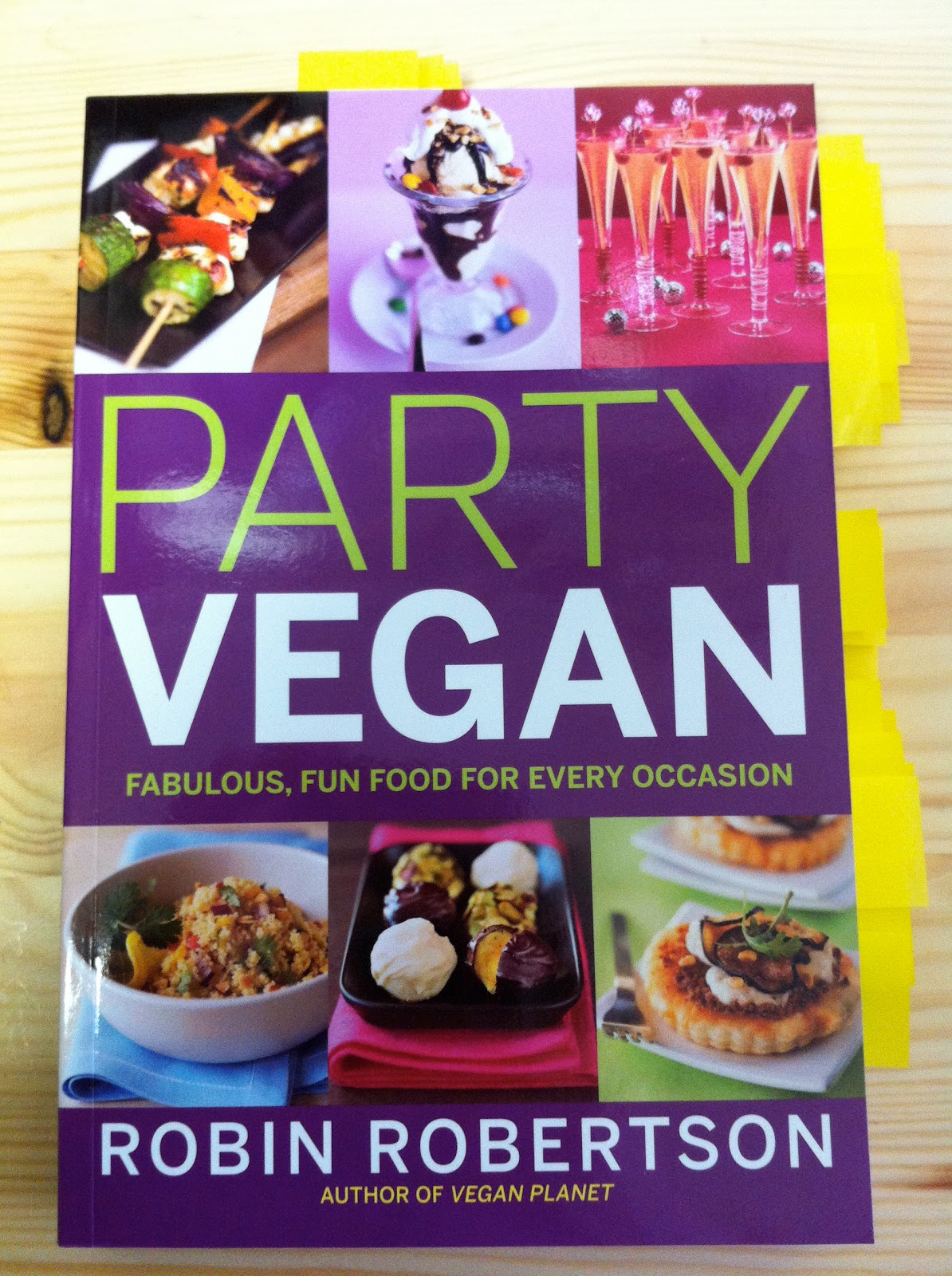
  • I love this book because it has a bunch of full menu ideas for a party and then is organized into recipes by party theme.  The recipes sound complicated but I can follow them easily (I don't do complicated recipes! No time!)
  •  For example, the first chapter is "A Dinner Party" and the recipes are:  "Artichoke Tapenade, Sun-dried Tomato & Green Olive Biscotti (made this tonight--with gluten-free flour of course--OUT OF THIS WORLD AMAZING!), Butterhead & Radicchio Salad with Walnut-Pesto Dressing, Wild Mushroom Ragu over Polenta and Orange-Kissed Chocolate Tiramisu!!"
  • The themes range from a "Child's Birthday Party" menu to a "Super Bowl Party" with some formal menus as well (the formal menus do seem more complex however)!
  • The recipes are very straightforward--easy to throw together.  When I saw the word "biscotti" I was a bit intimidated but it was actually pretty simple to prepare!  She clearly indicates if something is complicated or simple.
  • You do need to find substitutes for oils and fats in the recipes 
  • I'm a huge fan of "party food" so its nice to have a book to use.  Her "Finger-Lickin Tempeh" recipe is online--also see my post.

  • Whimsical and fun--great variety of fantastic ethnic food, a lot of curries which is great!  We cook the curries in the slow cooker which saves time :-)
  • Nutritional info with every recipe, no more than 400 calories per serving
  • Main dish focussed which is nice, less emphasis on appetizers, etc.  
  • Excellent variety of vegetable options and recipes are healthy
  • New to me so I'm still getting to know it--did a lot of last week's menu from it:  the Butternut Coconut Rice was AMAZING and the Vegetable Korma is a total hit!

Reference Books with Recipes
  • The first cookbook we used--fantastic simple recipes and great tips on learning how to cook without oil (surprisingly not as challenging as you would think!).  
  • Favorites:  Artichoke-Bean Dip (a hit at every party I've brought it to--I use it also as sandwich filler), Green Onion Hummus, Quick Black Bean Chili (but we make it with multiple types of beans)--SO good!
  • Excellent for beginners to the vegan, low-fat world because everything is very easy with very short, simple steps to prepare.

  • I use this book primarily for the reference data in the front but there are some good looking recipes in the back--haven't tried them yet.  
  • The table at the front is the basis for my anti-inflammatory food program


Coming Up:
  • Best of the Blogosphere from This Week & My FAVORITE Blogs!
  • How I Deal With Temptation...
  • Guest Post from THE HAPPY NURSE 
  • The Clear Skin Diet and My New Soy-Free Life!
  • And more....
    The medical information on this site is provided as an information resource only, and is not to be used or relied on for any diagnostic or treatment purposes. This information is not intended to be patient education, does not create any patient-physician relationship, and should not be used as a substitute for professional diagnosis and treatment.  Please consult your health care provider before making any healthcare decisions or for guidance about a specific medical condition. The Happy Rehab Doc expressly disclaims responsibility, and shall have no liability, for any damages, loss, injury, or liability whatsoever suffered as a result of your reliance on the information contained in this site.  By visiting this site you agree to the foregoing terms and conditions.

    Tuesday, November 15, 2011

    Using Food to Heal PAIN: Part 2: What Did I Do? Also, Effects on Arthritis, Acute Muscle Strains, Fibromyalgia, Chronic Pain, Chronic Fatigue, Heart Disease, Diabetes, Cancer!!

    Ok, the question you might be asking is what did I ACTUALLY do to treat my neck and back pain with food instead of NSAIDs (Mobic, Ibuprofen, etc)? As you saw in my last post on the power of the anti-inflammatory diet to reduce or reverse pain there is a very long list of both inflammatory and anti-inflammatory foods.   Discussing the literature is one thing, but what did I do in real life?


    Well, basically, I used that Anti-Inflammatory Book as a Bible but made a few tweaks of my own (me, doing it "my" way--shocking?!).  


    I first gave up all dairy (which actually wasn't that hard because I already wasn't eating cheese & I hadn't drank milk since I was a teenager because it caused recurent sinus infections).  I didn't notice a massive difference in my pain at that point, but it improved enough to make me a believer.  Then I gave up sugar & gluten--holy cow--HUGE improvement!  


    Sugar as an agent of inflammation wasn't a huge surprise to me.  Prior to these dietary changes, whenever I started to feel a cold coming on, I would immediately eliminate all sugar from my diet (including fruit) and eat a ton of nutrient-rich vegetables (SPINACH! Kale, broccoli, green beans, collard greens, etc).  If I did that the very first day I started to feel bad (as well as take 1 day dose of 50mg of Zinc & 1000mg Vitamin C), I rarely every progressed to getting the cold or sinus infection I was heading towards.  I honestly can't tell you why I made this choice--I think that probably about 10 years ago I read about improving children's immune systems in Dr. Leo Galland's book "Superimmunity for Kids" & some of that removing sugar to improve the immune system advice was in there!  Either way, it works like clockwork for me despite the fact that I work in a hospital and get exposed to nasty germs every day!  


    The whole gluten thing was a surprise to me though...so I had to do a little research.  One of my medical school classmates (and dear friend) had eliminated gluten from her diet because she was getting recurrent sore throats that stopped when she stopped eating it, so I knew that eliminating gluten from my diet would have some effects.  But, since I didn't have celiac disease (a disease that causes the body to reject gluten & cause severe intestinal & other dysfunction), I couldn't quite figure out why I got such a big bump in pain relief with the gluten elimination.  After researching it,  I now just think that maybe it is because wheat gluten isn't what it used to be.  What do I mean by that?  Well, briefly--if I was eating wheat about 50 years ago I wouldn't recognize the wheat we eat today.  Compared to farmer's products in the past, todays wheat is extremely genetically modified--with many natural nutrients depleted over time.  So my body obviously doesn't like our wheat!  I'll be happy to share more about that research in a future post, but I could go on forever about that so lets focus on the PAIN stuff some more.


    Around the time I stopped sugar and gluten I also stopped caffeine!!  I cannot believe that I forgot to mention this in my earlier posts!  It was seriously one of the HARDEST things I've ever done.  I felt horrible stopping the caffeine--a headache that didn't budge for a week was so painful to work through.  But once again, on the other side--less pain, more alert brain.  Crazy how this all works!  I should note that the majority of my caffeine consumption was tea.  I didn't really drink much coffee or sodas even before giving up caffeine.  My "no coffee rule" was because back when I was obese I constantly had GERD (reflux/heartburn) and I eventually gave myself a severe case of gastritis that forced me to eliminate the coffee that kept me awake for most of med school!  My "no soda rule" was because sodas actually contain phosphorus which leaches the calcium out of your bones putting you at much higher risk for osteoporosis as you age.  Yup, its true folks--but sometimes its hard to get that message out about such a profitable product!  I'll write in a future post about why diet sodas are particularly bad (they damage your bones AND they change the way you store your fat so it makes it harder to lose weight)!


    Tomatoes, Potatoes, Corn & Citrus fruits didn't really seem to alter my pain levels so I kept them in.  I already don't drink b/c we're 12 steppers so no alcohol to eliminate!  


    So I marched along without sugar, gluten or caffeine while consciously eating more Omega-3's, nutrient rich veggies on that anti-inflammatory list, berries, garlic, Roobios team (no caffeine), quinoa (my fav) and other grains.  I did this while maintaining a daily professional traction machine & exercise regimen prescribed by my PT for my neck.  I was doing all those PT directed activities before the food changes so I believe I can isolate the food changes as an independent variable (science speak).  In other words, I think I can safely say that the food was the main thing that changed, and after that change, the pain improved enough to get off the daily anti-inflammatory meds (normal people speak)!  


    THEN, comes the Vegan thing.  Literally about 2 weeks after giving up meat of all kinds (beef, pork, chicken, turkey, fish etc)--I was pain-free nearly all the time.  I even noticed that in the weeks prior to the initiation of the Vegan program we had been cooking out a lot on the grill (with delicious meat from a local beef farm of course--support local farmers!) & my pain seemed to be a bit higher in those weeks despite the lack of sugar, gluten or caffeine.  Then BOOM--goodbye meat, goodbye pain.


    So there you go--thats my story!  Remember of course, my repetitive caveat to read my medical disclaimer below!!! 


    Here are a few comments on specific ailments: Arthritis, Acute Muscle Strains, Fibromyalgia, Chronic Pain, Chronic Fatigue, Heart Disease, Diabetes and Cancer.  Please remember that the majority of the findings discussed below are still deemed "inconclusive as effective" in large scale peer-reviewed research studies--however, I believe there is enough quality data (even in small studies) to support at least considering dietary changes for treating or supplementing treatment of the following conditions.  The arthritis data however ARE very well supported in the literature (see the link below).


    1) Arthritis:  eliminating anti-inflammatory foods obviously has a major and rapid impact on this inflammatory condition.  There should be no such thing as "I'm growing old at 50 and my joints hurt"--seriously--I mean it--seriously!  I spent over an hour with a patient a few weeks ago who could barely walk due to his arthritis--he committed to making dietary changes & I can't wait to see him walk into the office in a few months.  I am that big a believer in this! 


    A few excellent resources on food as medicine for Arthritis include an outstanding article written by Dr. Neal Barnard from the Physicians for Responsible Medicine.  You can read it here: http://www.pcrm.org/health/health-topics/foods-and-arthritis


    2) Back strain, sprained ankles, tendonitis etc--all of these are examples of injuries with acute or chronic inflammation.  Basically the body has a very smart response to injury--in non-medical speak: it draws on its own resources to infiltrate the damaged areas, heat them to protect them from bacteria & stimulate the tissue to heal.  So inflammation is a good thing actually.  But when you pile on a bunch of additional sources of inflammation like food and chronic inflammatory diseases like Diabetes or Heart Disease, the inflammation can get out of control & healing can be prolonged.  


    When I face those situations, I recommend eliminating every inflammatory food on that list immediately and starting to consume as many of the anti-inflammatory foods as possible.  Watch for yourself and see what happens.  Of course, the foods can only do so much to overcome the power of inflammatory diseases like Diabetes or Heart Disease but if you aren't severely ill with a chronic disease, I'll bet you'll be surprised with how quickly the injury heals and the pain goes away! That is at least my own experience.


    3) Fibromyalgia & Chronic Pain Syndrome:  Both of these illnesses trap patients in a body that is extremely hypersensitive to normal stimuli.  What this basically means is that, if you touch a fibromyalgia patient during a flare, they are exceptionally sensitive to touch in particular areas of their bodies that occur in a very specific pattern.  They also are overwhelmed with fatigue (and in most cases, depression).  Chronic Pain patients feel pain when normal people do not--their nerve endings are so damaged that they are hyperactive, creating a seemingly "fake" response on physical exam.  True Chronic Pain Syndrome is very very real, and more common than I would like.  It is also accompanied by fatigue and depression.  


    Fibromyalgia and Chronic Pain patients are two of the most common patient groups in my specialty AND I believe they are two of the main groups that would benefit greatly from dietary treatment of their disease.  Many of these patients are as obese as I once was, and their bodies are in an overwhelming state of inflammation from the obesity ON TOP of the inflammation from the painful diseases!  I would love to see more doctors treating these patients with an anti-inflammatory, vegan diet before doing anything else (such as add narcotic medications to allow these people to function)!


    3) Diabetes, Chronic Fatigue, Heart Disease:   These are all diseases of chronic inflammation.  There is a particular marker of inflammation that the body puts out, its called C-reactive Protein (CRP).  When you measure the CRP in people, the result can be predictive of future heart dysfunction if the measurement is done when the patient is not in an acute state of illness. Once again, inflammatory disease, eliminate inflammatory foods (including  oils & fats according to Dr. Esselstyn) & add anti-inflammatory foods!


    4) Cancer:  I will devote a whole post to cancer in the future with regards to prevention & how to use foods for healing in conjunction with treatment by traditional Western Medicine.  I need to do some more research to supplement what I know but I can tell you this much.  First, significant studies have been done that demonstrate a reduction in cancer risk with adoption of an anti-inflammatory diet such as a vegan diet.  Second, any patient going through chemotherapy or radiation can tell you how exhausting and depleted the body feels.  They also do not feel like eating due to severe nausea, even though eating is the one thing that can boost their tolerance of the treatments!  They could possibly benefit a great deal by optimizing their intake of anti-inflammatory foods and eliminating inflammatory foods:

    1. to reduce the activation of cancer cells (as demonstrated in rat models with casein (found in animal products)-- Dr. Colin Campbell's original research)
    2. to provide them with the extra boost they need to manage the chemo and radiation process.  

    Ok!  That about wraps it up for this post!  Hope this information is helpful and looking forward to writing more about this in the future!


    ****
    After I wrote this I found some awesome posts from other bloggers on this topic!  Here are a few excellent ones:  


    1)  Healthy Librarian: Using Medical Journals to Guide Your Cooking!
    2) Vegan Epicurean (scroll down to the bottom to see her comments on a recent JHU conference!)
    3) Healthy Girl's Kitchen: great post on sugar!!!


    The medical information on this site is provided as an information resource only, and is not to be used or relied on for any diagnostic or treatment purposes. This information is not intended to be patient education, does not create any patient-physician relationship, and should not be used as a substitute for professional diagnosis and treatment.  Please consult your health care provider before making any healthcare decisions or for guidance about a specific medical condition. The Happy Rehab Doc expressly disclaims responsibility, and shall have no liability, for any damages, loss, injury, or liability whatsoever suffered as a result of your reliance on the information contained in this site.  By visiting this site you agree to the foregoing terms and conditions.
    Related Posts Plugin for WordPress, Blogger...